On my way to work today and running late, looking over I seen a man with a horse. Nothing unusual about that you may say. This was a soldier and his horse. Still nothing unusual? I parked the car and quickly made my way to the park, said hello, and asked if I could take some photos of this soldier and his horse. Delighted when he said yes, I opened my camera phone which was at the ready anyways, and took a few snaps. This was not just any soldier and his horse.
Meet Chris Iseppi and Banjo the horse from the Innisfail R.S.L Lighthorse Brigade. I'm no journalist but Chris was very accommodating in answering the questions I asked of what he was doing and about Anzac Day parade coming up on Friday 25th April.
Chris and Banjo along with two other horses were going to do a practise run through the town in preparation for Friday. Banjo was retrieved from a station near Chillagoe Queensland , he is 15 years old and took part in his first parade only two years ago. According to Chris, Banjo lead the parade and never put a hoof out of place, he stayed in step the whole time.
It was truly awesome to see Chris dressed as a soldier from The Light Horse Brigade, the uniform itself looked as though it would of been difficult to wear comfortably.... thick, and it felt very scratchy to touch.

I spoke to Chris again after lunch after tracking him down to the R.S.L (Returned Serviceman's Leagues) Club and he informed me that the practise run with Banjo and the other horses went without a hitch. Once more, Banjo stayed true to form and was never spooked even when an ambulance came up behind him in an emergency with sirens blaring.
I look forward to seeing the parade on Anzac Day, watching Banjo, Chris and the rest of the team, the local school children and various clubs from the town march and commemorate a day of great reflection.
At Federation, Australia was at war. 838 Officers 15,327 Other Ranks and 16,314 Horses saw service in the South African conflict by the time it concluded in 1903. New South Wales had sent Lancers (New South Wales Lancers), Heavy Cavalry (The Australian Horse), Mounted Infantry (New South Wales Mounted Rifles), and Light Horse (Australian Commonwealth Horse); other states had sent Mounted Infantry (Queensland Mounted Infantry, Victorian Mounted Rifles, Tasmanian Mounted Infantry, South Australian Mounted Rifles, Western Australian Mounted Infantry) and Light Horse (Australian Commonwealth Horse). However, it was recognised in this conflict that horsemen exposed and at the gallop with short range "shock" weapons (swords and/or lances) were no match for rapid firing smokeless weapons particularly if channelled by obstacles into murderous killing zones.
Thus when "The Mounted Service Manual for Australian Light Horse and Mounted Infantry" was authorised for publication by Major General ETH Hutton, Commanding the military Forces of the Commonwealth of Australia in July 1902, Mounted Troops were divided into two categories:
Light Horse, required to:
- fight on foot in the offensive and defensive;
- perform duties classified as information gathering and denial, reconnaissance and screening; and
- afford "protection" from surprise for all bodies of troops both halted and on the march.
Mounted Infantry, required to perform only the duties pertaining to infantry who are temporarily provided with increased means of mobility.
All Australian mounted units were Light Horse, there is no record of Mounted Infantry units being raised. The proud colonial titles and traditions of the colonial units were from this point used for ceremonial only. Light Horse units used horse-holders to enhance mobility, in order to engage the enemy, the lighthorsemen would dismount, handing their reins to one of their number who would move the horses out of the combat area. A trained horseholder could handle up to five extra horses.
You can read more on the Light Horse Brigade here:
The Australian Light Horse
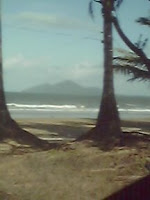
 The above photo was taken looking towards Ella Bay, you may be able to see it in the background. A beautiful beach largely unspoilt by loads of tourists. I cooked my first damper on a campfire at Ella Bay...what a disaster. All burnt and crusty on the outside and soft and gooey in the middle. Apologies for the darkness, but hopefully you can tell where the rainforest meets the beach...all this 10 minutes from my door.
 Taken at approximately 5:45pm from the boat ramp at Flying Fish Point looking up the Johnstone River which winds its way back into town. This river was named after Robert A Johnstone who was an explorer and a policeman. The river abounds with many different species of fish including the much sought after barramundi. Many times I have been drag netting in here for bait, I was the one who stayed on shore holding one end of the net, be buggered if I'm going to be the next meal for the freshwater crocodile which inhabits the river. To the left of the photo is Coquette Point..that's where lots of posh people live, good for fishing but you get eaten alive by sandflies ..repellant doesn't work so you coat the legs and arms with river mud. Worked a treat then, am sure it still would !